
RankingDeals
Gaming & Entertainment

6 Best Board Games of 2026

Six board games compared for families, friends and newcomers: Catan, Ticket to Ride Europe, Wingspan, Pandemic, Codenames and Flip 7.

By RankingDeals Updated: How we rank

As an Amazon Associate I earn from qualifying purchases. Advertising & Monetization Disclosure.

Quick answer

The best choice for most people is the Catan (9.2/10). Easy to teach, endlessly replayable and built around trading and negotiation, it is the safest single pick for mixed groups.

Check price on Amazon

Also worth a look: Ticket to Ride Europe (Best for Families); Wingspan (Best Engine-Builder); Pandemic (Best Co-op).

Top picks at a glance

1

Catan

Best Overall
9.2/10

Our take

Easy to teach, endlessly replayable and built around trading and negotiation, it is the safest single pick for mixed groups.

Pros

  • Rules that new players learn in minutes
  • Constant negotiation keeps everyone involved
  • A different board every time

Cons

  • Dice can punish an unlucky player

Full review

Catan is the board game most people picture when someone says "modern board game", and it earns the top spot here because it does the most things well for the widest range of tables. You collect resources from the hexagonal island, trade with the other players, build roads, settlements and cities, and race to be first to the target score. Xataka describes it as a resource-management classic and a good way in for newcomers, and Wargamer files it under its beginner picks as an easy-to-learn game that turns competitive quickly. That combination is exactly why it leads: the rules fit in a few minutes of explanation, yet no two games play out the same way, because the board is assembled differently each time and the dice keep everyone involved on every turn. The heart of the experience is negotiation. Even when it is not your turn, you are bargaining, bluffing and deciding who to help, which keeps a four-player game lively in a way that quieter, solitary-feeling designs cannot match. It is a good fit for a first game night with friends who rarely play, and it rewards a second and third session as players learn to read the board and the trade market. The compromises are real. The base game is built for three or four players, so larger groups need an extension, and the dice can punish an unlucky player for a stretch of turns. A game of about 75 minutes also asks for more commitment than a filler. Players who dislike direct competition or being targeted by a trade embargo may find it stressful. The Spanish edition of the base game is the one the buy button leads to, so the rules and components are ready for a Spanish-speaking table. If you want a single board game that works for family, friends and newcomers alike, this is the safest recommendation on the list.

2

Ticket to Ride Europe

Best for Families
9.1/10

Our take

A calm route-building game that grows tense as the map fills up, with a standalone map that adds tunnels, ferries and stations.

Pros

  • Standalone Europe map, no original required
  • Tunnels, ferries and stations add choices
  • Suits children and adults alike

Cons

  • Luck of the card draw can frustrate planners

Full review

Ticket to Ride Europe takes the simple idea of the original railway game and adds just enough new rules to make it feel fresh. You collect coloured train cards, claim routes between European cities and complete secret destination tickets for bonus points. Xataka sums the series up as building the longest railway routes and notes the debate over whether the original or the Europe version is better, while Wargamer lists Ticket to Ride among its beginner picks as a calm game that becomes tense as the map fills up. Both observations match what makes it a strong family choice: you can explain it in two minutes, but you will soon start watching which routes your opponents are chasing. What separates the Europe map from the first one is the extra layer of choices. Tunnels add a little risk when you claim them, ferries need special locomotive cards, and stations let you borrow an opponent's route if you are blocked. These additions give experienced players more to plan without making the game harder to teach, and the box is a standalone game that does not require the original. It suits two to five players and plays in roughly 30 to 60 minutes, so it fits a weeknight as easily as a weekend. Children from eight can follow it, and adults will not feel they are playing down to them, which is rarer than it sounds. The trade-offs are modest. Luck of the draw with the train cards can frustrate a careful planner, and there is little direct interaction beyond blocking routes. Competitive groups who want more depth may outgrow it, while newcomers will find it among the friendliest entry points available.

3

Wingspan

Best Engine-Builder
9.0/10

Our take

A relaxed, beautiful engine-builder that suits players who want more depth than gateway games without direct conflict.

Pros

  • Satisfying chains of actions build up
  • Little direct conflict, so relaxed to play
  • Includes a solo mode

Cons

  • Card text can overwhelm newcomers
  • Mostly played on your own board

Full review

Wingspan is the engine-builder on this list, and the one that most clearly bridges lighter gateway games and heavier strategy. Each player is a bird enthusiast attracting species to three habitats, and every bird you add triggers abilities that make later turns more rewarding. Wargamer calls it a beautiful engine-builder that bridges gateway and deeper strategy games, and Xataka includes it among its large selection of essentials, which fits the broad consensus about its appeal. The first few turns are quiet and exploratory, but by the end of the game your row of birds is producing chains of actions that feel earned. Presentation is a large part of the appeal. The publisher's box art and the detailed bird illustrations make the game a pleasure to leave on the table, and the educational touch of real species information gives it a different character from most strategy games. It is also unusually relaxed: there is little direct attack, so a table of friends who dislike confrontation can play without tension. It supports one to five players with a solo mode, and a game takes about 40 to 70 minutes. The recommended age is 14 and up, which reflects the number of card abilities to keep track of rather than any difficult content. There are downsides. New players can feel overwhelmed by the amount of text on the cards, and the English second edition is the version the buy button leads to, so check how comfortable your group is with it. It is also less social than Catan or Codenames, since most of the game happens on your own board. If you want a game that feels like a hobby rather than a party, and you like seeing a plan come together, this is the strongest pick for that kind of player.

4

Pandemic

Best Co-op
8.9/10

Our take

A challenging cooperative game in which the whole table fights together to cure four diseases before time runs out.

Pros

  • The whole table wins or loses together
  • Adjustable difficulty keeps it fresh
  • Good for mixed ages and experience

Cons

  • A dominant player can direct everyone

Full review

Pandemic is the cooperative pick, and it is the clearest example of a game that turns a table of competitors into a team. Players take on roles such as medic or scientist and travel the world map to treat outbreaks and find cures for four diseases before the board spirals out of control. Wargamer lists it among its beginner picks as a challenging and satisfying co-op game about fighting disease, which sums up the experience well: it is easy to learn, but a typical session is a genuine fight to avoid losing. The cooperative structure changes the way people talk. Instead of guarding secrets, you discuss every move, combine abilities and argue about whether to cure now or contain an outbreak first. That makes it a good choice for families, couples and mixed groups where one confident player might otherwise dominate a competitive game. Difficulty can be raised by adding more epidemic cards, so the same box stays interesting once you win a few times. It is for two to four players, takes around 45 minutes, and is recommended from eight years of age. The listing we compared is the Z-Man edition of the base game, which is the one the buy button opens. Cooperative games share a known weakness: a strong player can start telling everyone else what to do, which drains the fun. The game can also feel bleak when the draw is unlucky, and the theme of spreading disease may not suit everyone. Fans of the franchise who want a campaign should know that the legacy versions are separate products and not this one. For a first cooperative game, though, it is the most dependable choice here.

5

Codenames

Best for Groups
8.8/10

Our take

A quick team word game that works for large groups and mixed ages thanks to a rule set that takes a minute to explain.

Pros

  • Explained in about a minute
  • Short rounds and plenty of laughs
  • Works for different ages on equal terms

Cons

  • Needs four or more players to shine

Full review

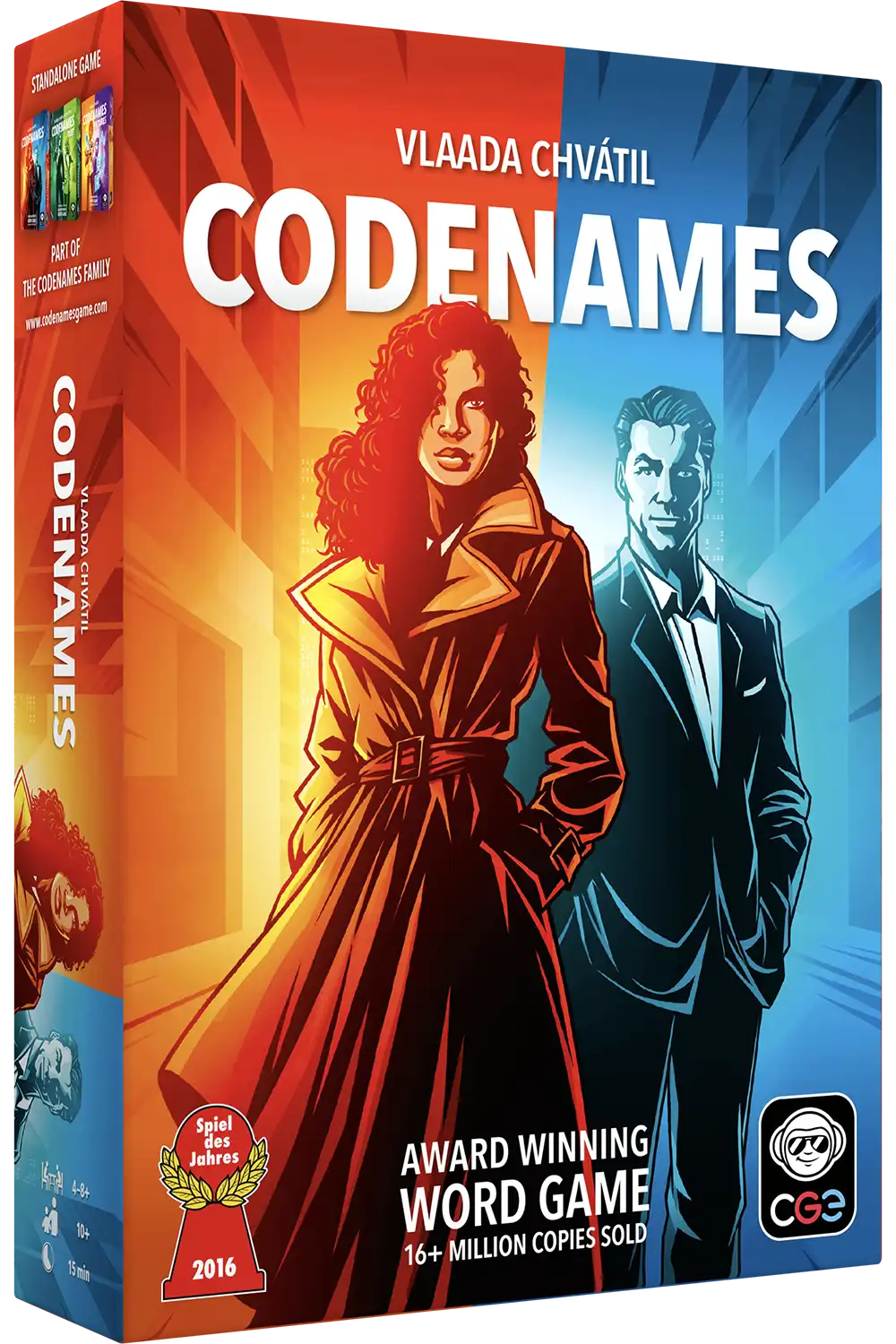
Codenames is the party game of the list, and it works because the rule set is so small. Two teams of spies try to find their own agents on a grid of words, guided by one-word clues from their spymaster. Wargamer describes it as a quick, easy word-association espionage game that is always fun to introduce, and Xataka summarises it as spy teams using word-based clues to identify their agents. Together these capture why it works at gatherings: the explanation takes a minute, a round is short, and every clue gives the table something to argue about. The best moments come from the gap between what the clue-giver means and what teammates hear. A single word that links three cards can lead to a satisfying round, or to a disastrous guess that hands the opponents the win. Because the cleverness is in language and not in rules, mixed groups of different ages and gaming experience can play on equal terms. It needs four or more players to work well, so it is less useful for a quiet evening for two, and a round lasts around 15 minutes. The box is a standalone game, and Spanish players will find a Devir edition of the word game, which is the one the buy button opens. Variants with pictures or for two players exist as separate products. The weaknesses are predictable. Players who dislike being put on the spot, or who need a lot of time to think, can feel pressured, and a strong spymaster can dominate a table. Outside a group of four or more, the game loses its charm. If you want a quick game that gets people talking, it is hard to beat.

6

Flip 7

Best Quick Filler
8.6/10

Our take

A very quick push-your-luck card game that scales to large groups and is easy to teach to anyone at the table.

Pros

  • Learned in a minute
  • Scales to very large groups
  • Special cards keep rounds varied

Cons

  • Very little strategy
  • Luck outweighs planning

Full review

Flip 7 is a fast press-your-luck card game that has quickly become a favourite for large groups. Each round you turn over cards one by one and decide whether to stop and bank your points or risk another flip; if you draw a number you already hold, you bust and lose the round. Hola calls it the best game to take to a family gathering, describing a Blackjack-style card game that works well with large groups, and Wargamer lists it among its family picks as a quick, moreish push-your-luck game that is easy to teach. That is a fair description of what it does well: the rules are explained in a minute and a new player can join mid-evening. The deck contains special cards that freeze players, give a second chance or add bonus points, which adds just enough variety to keep each round different. The first player to reach the target score wins the game, and a large table can play together because the game scales from three players up to eighteen. It is the lightest game on the list, and it earns sixth place for that reason. There is less to plan and far more luck than in the others, so players who want deep strategy will quickly feel they have seen everything. Several editions exist, and the Spanish-market listing the buy button opens is the standard USAopoly card game. A harsher standalone follow-up exists for groups who want more take-that play. If you need something to pull out when relatives or friends arrive and nobody wants to read a rulebook, Flip 7 is a useful addition to a shelf of larger games. Treat it as a filler between longer games, not as the centrepiece of an evening.

Frequently asked questions

What is the best board game for beginners?

Look for rules you can explain in a few minutes and a game that stays interesting on repeat plays. Catan and Ticket to Ride are the classic gateway choices because new players pick them up quickly, while a cooperative game such as Pandemic suits groups who prefer to work together instead of competing.

How many players should I plan for?

Check the player count before anything else. Catan is built for three or four, Codenames works best with four or more, and Flip 7 can handle a large party. If your group is often just two people, look for games with a dedicated two-player mode or a solo option, such as Wingspan.

Are board games suitable for young children?

Some are, but check the manufacturer age. Ticket to Ride and Pandemic are listed from eight years, Catan from ten and Wingspan from fourteen. For younger children, choose a simpler game with short turns and avoid titles with long rulebooks, since the fun disappears when the rules take too long to explain.

Buying guide

Picking a board game is harder than it looks, because the best one depends on who is sitting at the table. A game that delights a group of experienced players can bore a family with young children, and a party game that fills a room with laughter can feel thin on a quiet evening for two. This guide compares six well-regarded titles that cover the most common situations: a first game for newcomers, a family favourite, a deeper engine-builder, a cooperative challenge, a party game for large groups and a quick filler. We built the list by comparing what several independent guides say about the games that keep getting recommended, and by checking what the publishers themselves state about player counts, age and length. Start by counting players, because that single number rules games in or out. Catan needs three or four, Codenames shines with four or more, Flip 7 scales to a crowd, and Wingspan even has a solo mode. Then think about how your group likes to interact. Some tables enjoy negotiation and direct competition, while others prefer a cooperative game in which everyone wins or loses together, or a relaxed engine-builder where each person builds their own board in peace. Playing time matters just as much. A game of about 75 minutes asks for an evening, whereas a quick card game can fill the gap before dinner. Be honest about the age of the youngest player too: the recommended ages here range from 8 to 14, and a game that is too complex quickly ends up unused on the shelf. Finally, check the language of the edition. Most of the games here have Spanish editions, but a few listings are in English, and card-heavy games like Wingspan are easier when everyone is comfortable with the text. If you are buying a gift, a gateway game with simple rules is almost always safer than a complex strategy title. Whatever you choose, remember that a board game is a shared activity: the right choice is the one your table will actually ask to play again.

Ranking methodology

Our score is an out-of-10 assessment that weighs what the reviews we consulted conclude about each game across gameplay, quality of components, ease of learning and value for money. For board games we gave the most weight to how easily a game gets people to the table and how well it holds up across repeat plays. Since construction quality is judged differently for a card game than for a large box, we looked instead at how the components support the experience. It is not an average and not a measure of agreement between sources.

Sources consulted Based on Xataka, Wargamer, Hola, and 3 more

The reviews and data this ranking draws on. We do not run our own lab tests: we compare the findings of these publications.

Tags

More rankings you may like