Baby & Kids

6 Best Infant Car Seats of 2026

Our guide to the 6 best i-Size infant car seats of 2026, compared on ADAC crash results, installation, weight and pushchair compatibility.

By RankingDeals Updated: How we rank

As an Amazon Associate I earn from qualifying purchases. Advertising & Monetization Disclosure.

Quick answer

The best choice for most people is the Thule Maple (9.3/10). Best ADAC result in our list with its Alfi base, very easy to install correctly and a smooth 180-degree rotation.

Search on Amazon

Also worth a look: Cybex Cloud T i-Size (Best for Pushchairs); Joie Sprint (Best Without a Base); Maxi-Cosi Coral Slide Pro (Best Slide-Out Base).

Top picks at a glance

1

Thule Maple

Best Overall
9.3/10

Our take

Best ADAC result in our list with its Alfi base, very easy to install correctly and a smooth 180-degree rotation.

Pros

  • Digital indicators and audible alerts confirm a correct installation
  • Releases easily from the base and from compatible pushchairs
  • Rotates towards the door, making it easier to load the baby

Cons

  • The base is a separate purchase
  • Shorter height range than carriers that reach 87 cm

Full review

The Thule Maple is the infant carrier we would put in front of most families. It is an i-Size seat for babies from 40 to 75 cm and up to 13 kg, and its biggest strength is the combination with the Alfi ISOFIX base: with that base it reached a good 1.6 in the ADAC child seat test, the best figure among the seats in our list. Made for Mums also highlights how intuitive the installation is, with digital indicators and audible alerts that confirm the base is fitted correctly, which matters because a poorly installed seat protects far less. Day-to-day use is where the Maple earns its place at the top. The carrier releases from the base or a pushchair easily, and when it sits on the Alfi base it rotates 180 degrees towards the door, so you can strap in or lift out a baby without twisting your back. The seat is compatible with Thule travel systems, which saves buying separate adapters. It can also be installed with the adult seat belt, although then you lose the features of the base. What it sacrifices is length of use and convenience. It covers a shorter range than carriers that go up to 87 cm, so many babies will outgrow it at around twelve months, and the base is a separate purchase. It is also heavier than the lightest carriers, at about 5.4 kg. Because the Maple is sold in Spain through Thule's own channels and specialist retailers, finding the right base and accessories is straightforward. Choose it if you want the strongest independent safety result and an installation that is hard to get wrong, and you are happy to move to a larger seat once your baby reaches the height limit.

2

Cybex Cloud T i-Size

Best for Pushchairs
9.2/10

Our take

A comfortable, long-lasting carrier with a rotating base, a lie-flat recline and wide pushchair compatibility.

Pros

  • Lie-flat position on a pushchair frame
  • Twelve headrest positions to adapt as the baby grows
  • Adapters let it fit pushchairs from other brands

Cons

  • The Base T is expensive and heavy
  • Seat-belt installation removes the spin function and i-Size classification

Full review

The Cybex Cloud T i-Size is the carrier to choose if you want a lie-flat posture and plenty of pushchair options. It fits babies from 45 to 87 cm and up to 13 kg, so it can last close to two years for many children. Made for Mums reports an ADAC rating of 1.7 with the Base T and 2.1 without it, both good, which is why the seat sits so high in our list even though it is not the very best performer. The Cloud T is designed around comfort. Its ergonomic recline in the car and a lie-flat position on a compatible pushchair frame are the main selling points, and it has twelve headrest positions to grow with the baby. It works with Cybex pushchairs and, through adapters, with other brands, which makes it a strong choice for families who already own a stroller. The base rotates 180 degrees, so loading a baby is less of a struggle than with a fixed base. There are trade-offs. The Base T is expensive and heavy, and the seat itself weighs around 4.5 kg. Installing the carrier with the seat belt removes both the spin function and the i-Size classification, so for the best result you really need the base. The ADAC figure also drops when the seat is used without it, which is another reason to treat the base as part of the purchase. Overall, this is a polished, long-lasting carrier for families who want flexibility between car and pushchair and do not mind paying for a base.

3

Joie Sprint

Best Without a Base
9.0/10

Our take

A light R129 carrier with ISOFIX built in, so there is no base to buy, and a very good ADAC result.

Pros

  • No separate base to buy or move between cars
  • Quick click-in installation with clear indicators
  • Light enough to carry comfortably

Cons

  • Relatively short period of use
  • No rotation, so loading the baby takes more effort

Full review

The Joie Sprint solves a problem many families have: it gives you a modern R129 carrier without a separate base. Its ISOFIX connectors are built into the shell and deploy from the seat itself, so you click it into the car and the indicators show you it is secure. Made for Mums reports an ADAC rating of 1.8, a very good result for a seat that is also one of the lightest in the list at about 4.1 kg. This simplicity is its main advantage. With no base to buy or carry between cars, the Sprint is a good choice for a second vehicle or for grandparents who drive the baby occasionally, and it is easy to take on a trip. It fits babies from 40 to 75 cm and up to 13 kg, which is a typical range for a carrier, and it is compatible with selected Joie pushchairs. A UPF50+ hood protects the baby from sun on summer journeys. The compromise is the lack of a rotating base. Without one, you have to lean into the car to fit the baby, which can be hard on the back if the door opening is narrow or the baby is heavy. The lifespan is also short, around twelve months, so you will be looking for the next seat sooner than with a carrier that reaches 87 cm. The seat does not give you the 180-degree comfort that the top picks provide. If you want a safe, light seat that is simple to install and easy to move between vehicles, the Sprint is the one to choose.

4

Maxi-Cosi Coral Slide Pro

Best Slide-Out Base
8.8/10

Our take

A new carrier with a slide-out base and the best ADAC result in the autumn 2026 round.

Pros

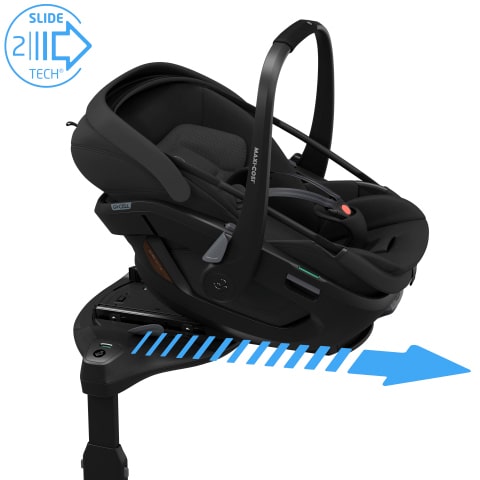
  • The base slides out towards the door to make loading easier
  • G-CELL side-impact protection and a newborn insert
  • Wide height range that lasts up to roughly two years

Cons

  • Works only with its own FamilyFix Slide Pro base
  • Newer, with fewer independent reviews than long-established seats

Full review

The Maxi-Cosi Coral Slide Pro is the newest seat here, and in ADAC's autumn 2026 round it achieved the best result of that test, a good 2.1 with its FamilyFix Slide Pro base. It is an i-Size carrier for babies from 40 to 87 cm and up to 13 kg, which Maxi-Cosi describes as a use of up to about 24 months, and it includes G-CELL side-impact protection and a newborn insert for babies from 40 to 60 cm. The distinctive feature is SlideTech. With the optional base, the seat slides out towards the car door by about 27 cm, so you can load or lift the baby without reaching deep into the back of the car. That is a real benefit in a small car or a crowded parking space, and it helps parents with back problems. The seat is made to be light for the carrier, and Maxi-Cosi pairs it with its lightest strollers to make a compact travel system. Know the limits. The seat works only with the FamilyFix Slide Pro base, which is sold separately and is not compatible with the other Maxi-Cosi bases, so you cannot reuse a base you already own. Its ADAC score of 2.1 is good but not as strong as the Thule or Cybex results with their bases. Because it is new, there are fewer independent reviews than for long-established seats, so we rank it below those that have more evidence behind them. It is a strong option for a family that wants the newest design, low effort loading and a Maxi-Cosi pushchair, provided they buy the right base.

5

Joie i-Gemm 3

Best for Joie Strollers
8.6/10

Our take

A straightforward carrier with a good ADAC result and a 90-degree swivel base, ideal for Joie travel systems.

Pros

  • Fits with a range of Joie strollers
  • Can also be installed with other Joie bases or the seat belt
  • Good ADAC result with its swivel base

Cons

  • The base rotates only 90 degrees and is heavy
  • Fewer extras than the leading carriers

Full review

The Joie i-Gemm 3 is a sensible, well-supported carrier, and it is the pick for families who have or plan to buy a Joie pushchair. It is an i-Size seat for rear-facing travel from 40 to 85 cm, from birth to 13 kg, and weighs about 4.5 kg according to Joie's own product page. In ADAC's autumn 2026 results it earned a good 2.2 with the i-Base Encore base. The partnership with the i-Base Encore is where it shines. That base swivels 90 degrees, helping you load the baby from the door, and the seat can also be fitted with other Joie bases or the seat belt. The i-Gemm 3 is compatible with a range of Joie strollers, with click-on adapters listed for several of them, and it also works with other pushchairs using the right adapters. This makes it a good way to build a complete travel system without being tied to a premium brand. The compromises are visible when you compare it with the leaders. The base turns only 90 degrees, rather than the full 180 of the top choices, and it is heavy at about 7 kg, so it is best left in one car. The ADAC figure is solid but behind the best rivals in our list, and the seat is a basic design without the extra headrest positions or sliding features of pricier carriers. It is also a simple model that has not been singled out by independent reviewers. Choose it for a straightforward, good-rated carrier that fits neatly into a Joie travel system.

6

Doona i

Best Car Seat Stroller
8.4/10

Our take

A carrier with built-in wheels and a strong ADAC result, but heavy and best for short trips.

Pros

  • Turns into a stroller without unfastening the baby
  • Harness adjusts automatically with the headrest
  • Includes side-impact protection

Cons

  • Heavy, at around 8 kg
  • No integrated storage and best for short trips

Full review

The Doona i is a different kind of product: an i-Size infant carrier with wheels built in, so it turns into a stroller in seconds. Made for Mums reports an ADAC rating of 1.7 with the base, a result on a par with the best here, and the seat suits babies from 40 to 85 cm up to 13 kg. If you live in a city and make many short car trips, the idea of never having to unfasten a sleeping baby is very appealing. Its character shows in the details: a harness that adjusts automatically with the headrest, side-impact protection and a roomy, comfortable interior. The wheels fold out from underneath the shell, so you can go from car to pavement without any other equipment, and it is easy to move around a shop or an airport. It works as a travel solution for families who do not want to carry a bulky pushchair around. You pay for that convenience in weight and compromise. At about 8 kg, the Doona i is the heaviest infant carrier in the list, which makes it hard to lift in and out of a car. As a stroller it is a small, short-term solution rather than a proper pushchair, with limited storage and a ride that suits only the first months, and a baby should not stay in it for hours. The i-Size classification also depends on being installed with the dedicated base. For that reason it ranks last despite its strong safety figure: it is an excellent tool for the right family, but not the best all-round carrier. It makes sense if you value a very compact transition from car to street above everything else.

Frequently asked questions

What does i-Size mean on an infant car seat?

i-Size is the name of the UN R129 approval. It selects the seat by the baby's height instead of weight, requires rear-facing travel for infants, includes side-impact testing and makes ISOFIX installation the norm. It is the current standard, so a new infant seat should carry R129 on its label.

How long can a baby use an infant carrier?

Most carriers fit from birth up to about 75 to 87 cm or 13 kg, which usually means roughly the first twelve to twenty-four months. The limit that arrives first decides, and the head should stay below the top of the shell. Check the manufacturer's height range and move to a bigger rear-facing seat when it is reached.

Is a seat with an ISOFIX base safer than installing it with the seat belt?

A base makes correct installation easier, with indicators that confirm the fitting, and some bases rotate to help you load the baby. Seat-belt installation can be safe when done properly, but it removes base features and, on some models, the i-Size classification. Always follow the manual.

Can my baby sleep in the car seat at home?

No. Infant carriers are designed for travel, and a baby left asleep in one outside the car, or for long periods, can slump and have trouble breathing. Move the baby to a flat, firm sleep surface as soon as you arrive, and take regular breaks on long journeys.

Buying guide

An infant car seat is the first safety product most families buy, and it is used from the very first journey home from the maternity ward. In Spain and the rest of Europe the current approval is UN R129, known as i-Size, which sets seats by the baby's height rather than weight, requires rear-facing travel and includes side-impact testing. The older R44 approval still exists on the second-hand market, but we only compare modern R129 infant carriers here. The OCU explains that babies should travel facing backwards until at least 15 months, and the seats in this list are all rear-facing carriers that click onto an ISOFIX base or, in one case, have the connectors built into the shell. To pick the six, we compared independent crash and usability results, above all the ADAC child seat tests, which grade safety, handling, ergonomics and harmful substances, and the buying guides of specialist parenting media such as Made for Mums. We also checked each manufacturer's published height and weight limits. ADAC's autumn 2026 round is a reminder of why results matter: a Britax Römer Baby-Safe Pro on its Vario Base 5Z was rated insufficient after the harness buckle opened in the lying position of a frontal crash, and the Axkid Minikid Core also failed. Neither appears here. The seats we recommend all reached a good rating in the ADAC results we could read. Think about three things before you choose. First, the car: ISOFIX anchor points, rear-door width and the length of the front passenger space all change how a rear-facing seat fits, so check the manufacturer's vehicle list. Second, the base: a rotating base makes it far easier to lift a sleeping baby in and out, while a seat with built-in ISOFIX saves money and space but gives up that convenience. Third, how long you will use it: infant carriers last roughly twelve to twenty-four months, after which the baby moves to a larger rear-facing seat. Some practical rules apply to every seat. Always follow the manufacturer's instructions for the harness height and the newborn insert, never use extra padding that did not come with the seat, and do not leave a baby in a carrier for long stretches: it is made for travelling, not for sleeping at home or on a pushchair frame for hours. Take regular breaks on long journeys. A seat that has been in a crash should be replaced. This ranking helps you choose an infant car seat, but it does not replace the advice of a paediatrician or midwife.

Ranking methodology

Our score out of 10 weights what the reviews we consulted conclude about crash safety, build quality, ease of use and value for money. In this category safety counts most, so independent results such as ADAC's carry the greatest weight, followed by how easy it is to install correctly, because a seat that is fitted wrongly protects less. Build quality and everyday handling, such as weight and pushchair compatibility, come next. We do not present the score as an average or as a measure of how much the sources agree.

Sources consulted Based on ADAC, Made for Mums, OCU, and 3 more

The reviews and data this ranking draws on. We do not run our own lab tests: we compare the findings of these publications.

Tags

More rankings you may like