Gifts

6 Best Gifts for One-Year-Olds of 2026

Six first-birthday gift ideas for one-year-olds: blocks, a pounding bench, a push wagon, beeswax crayons, a plush bunny and an easy-grip ball.

By RankingDeals Updated: How we rank

As an Amazon Associate I earn from qualifying purchases. Advertising & Monetization Disclosure.

Quick answer

The best choice for most people is the Mega Bloks First Builders Big Building Bag (9.2/10). A bag of 60 large, easy-to-grip blocks that guides recommend for first builders and that keeps being useful as the child grows.

Check price on Amazon

Also worth a look: Hape Pound & Tap Bench (Best for Cause and Effect); Radio Flyer Classic Walker Wagon (Best for First Steps); Honeysticks Originals Beeswax Crayons (Best Creative Gift).

Top picks at a glance

1

Mega Bloks First Builders Big Building Bag

Best Overall
9.2/10

Our take

A bag of 60 large, easy-to-grip blocks that guides recommend for first builders and that keeps being useful as the child grows.

Pros

  • Chunky pieces suit small hands
  • Useful from first stacking to imaginative building at three
  • The zip bag makes tidying part of the game
  • Needs no batteries or setup

Cons

  • Plain look for a milestone present
  • No sounds or lights, so some children want more stimulation

Full review

The Mega Bloks First Builders Big Building Bag is the gift we would suggest to most people, because it fits almost any one-year-old and keeps working long after the first birthday. The bag holds 60 oversized blocks in a range of shapes and colours, sized for small hands that are still learning to grip, press and release. Guides we read, including Fatherly and Busy Toddler, single it out for exactly that reason, and the Spanish magazine Diez Minutos lists it among its picks for children from one to two years old. At twelve months the play is simple and satisfying: filling and emptying the bag, banging two blocks together, and knocking down a tower you have built for them. By eighteen months they start to stack deliberately, and by two or three they build enclosures, vehicles and animals. Few toys cover that much developmental ground, and the blocks also connect with other toys in the same system, so the set can grow with the child. The bag itself is useful as well: it zips shut, doubles as storage and makes tidying a game. The manufacturer describes the set as PVC-free, and the blocks are easy to wipe clean after a snack or a day at the park. What does it give up? It is not a showpiece. It has no sounds or lights, and the plain plastic looks less special than a wooden heirloom, so it can feel an ordinary present for a milestone birthday. Pairing it with a card or a small soft toy fixes that. The blocks also travel everywhere in a house, so expect to find a few under the sofa. If you can give only one thing, though, this is the safest and most versatile choice on the list, and the one most likely to still be played with at the age of three.

2

Hape Pound & Tap Bench

Best for Cause and Effect
9.1/10

Our take

A wooden pounding bench with three balls, a mallet and a slide-out xylophone, recommended by several parenting guides for cause-and-effect play.

Pros

  • Combines pounding, rolling balls and a xylophone
  • Wooden build feels solid and long-lasting
  • Needs no batteries and works the day it is opened
  • The xylophone can be played separately later

Cons

  • Balls and mallet are small, so adult supervision is a must
  • May bore older toddlers

Full review

The Hape Pound & Tap Bench is a classic first-birthday present, and it has earned a place in several of the guides we compared. Babylist and Busy Toddler both recommend it, and Fatherly lists a similar pounding bench in its own selection. The idea is wonderfully simple: the child drops or places three wooden balls onto the bench, taps them with the mallet, and watches them tumble down a slope. A slide-out xylophone adds a second way to play and a bit of music. That sequence is what makes it a good gift for this age. Hitting, watching and listening together teach cause and effect, hand-eye coordination and early rhythm, and the repetition is exactly what a one-year-old craves. Hape lists it from twelve months, and the wooden construction with a water-based finish feels more durable than much of the plastic competition. It is also quiet enough to be played with at the table without driving the grown-ups mad, apart from the xylophone. The xylophone can be pulled out and played alone, so the toy gets a second life as the child grows into using the mallet with more control. Many families find it still gets used at two. There are compromises. The balls and mallet are small enough that you should always supervise and keep the parts together, and the manufacturer sells replacements if something goes missing. Some children lose interest sooner than the guides suggest, and one reviewer noted a 2.5-year-old who was not especially keen, so it is best for the youngest end of the range rather than for older toddlers. It is also a toy that needs a flat, hard surface and a little patience from whoever is nearby. Still, as a gift that is easy to wrap, needs no batteries and gets used the day it is opened, it is hard to beat.

3

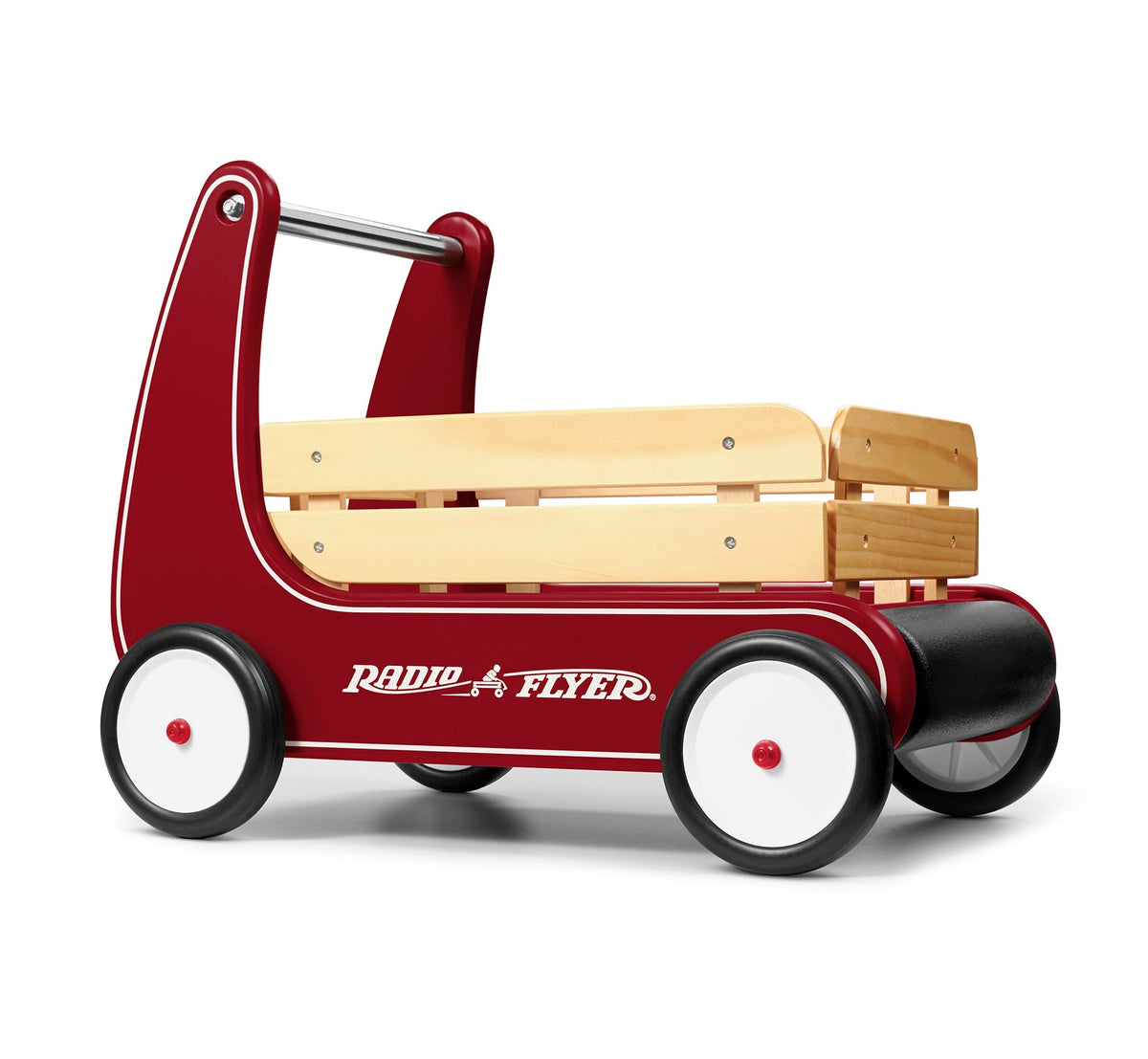
Radio Flyer Classic Walker Wagon

Best for First Steps
9.0/10

Our take

A wooden push walker with a cargo bin and resistance wheels, designed for a child's first steps and later used for pretend play.

Pros

  • Resistance wheels steady early walkers
  • Doubles as a cart for pretend play
  • Wooden build is sturdy and attractive
  • Long age range gives good lasting value

Cons

  • Needs adult assembly and has small parts before it is built
  • Bulky to store or travel with

Full review

The Radio Flyer Classic Walker Wagon is the one to choose if your one-year-old is pulling up, cruising or just starting to walk. It is a wooden push toy with a bar to hold, a bin to carry things in and wheels that resist when pushed, so a child learning to balance does not shoot off ahead of their feet. Busy Toddler recommends the Classic Walker Wagon, and Babylist includes Radio Flyer's push walkers among its favourites for early walkers. Radio Flyer lists it for ages one to four, and that long span is what makes it worthwhile. At first it is a stable support for wobbly steps. A few months later it becomes a cart to load with blocks, books and soft toys and trundle around the living room, which is imaginative play and gross-motor practice in one. The front bumper helps protect furniture and walls, and the wooden panels can come off. It is also a handsome object, with the red-and-natural-wood look that feels more like a keepsake than a plastic walker, so it makes a good present from grandparents or from a few people pooling together. There are trade-offs worth knowing. It needs adult assembly and has small parts before it is built, so keep those away from young children. It is heavier and bulkier than most gifts on this list, which matters in a small flat and for travelling. It is also not for sitting on or riding, and it should be used on flat floors and kept away from stairs. The resistance is fixed, so some very confident walkers outgrow the support quickly. Even so, for a child who is on the move, nothing else here encourages walking as directly, and it keeps being played with long after the walking is mastered.

4

Honeysticks Originals Beeswax Crayons

Best Creative Gift
8.8/10

Our take

A box of twelve chunky beeswax crayons designed for toddler hands and intended for children from one year old.

Pros

  • Short, thick shape suits a toddler's fist
  • Made without paraffin
  • Easy to wrap, store and share
  • Useful for several years

Cons

  • Needs close supervision and wipeable surfaces
  • Less instantly exciting than a toy that moves or sounds

Full review

Honeysticks Originals are beeswax crayons made for the smallest hands, and they are the pick on this list for families who want a present that starts a creative habit. The set has twelve short, chunky crayons that are easy to grip in a fist, which is how most one-year-olds hold anything. The company says they are made from pure beeswax and food-grade pigments, with no paraffin, and recommends them for children aged one to three. The Spanish magazine Diez Minutos includes them in its guide for children from one to two years old. At this age drawing is about the physical act more than the result. Pressing, dragging and scribbling build the muscles and control that later turn into writing, and watching a colour appear on paper is another small lesson in cause and effect. The crayons are short and thick, which makes them hard to snap, and they glide with little pressure, so a toddler gets a satisfying mark quickly. The mild honey scent is a nice touch for sensory play. As a gift they are easy to give and easy to store, and they pair well with a large pad of paper or a roll of plain paper taped to the floor. The main thing to remember is supervision. Even non-toxic crayons are not food, and many one-year-olds will taste them, so sit with the child while they draw and use washable surfaces. The wax can mark fabrics and walls, so choose where it is used. They do not give the instant brilliance of a felt-tip, and some children find the chunky shape awkward at first. Compared with the other gifts here they are the least physical and the least likely to be a showstopper on the day, but they are the most likely to be pulled out again and again for the next three years.

5

Jellycat Bashful Bunny

Best Keepsake Plush
8.6/10

Our take

A floppy plush rabbit praised in a gift guide as a lasting, easy-to-pack comfort companion for one-year-olds.

Pros

  • Soft, well made and easy to carry
  • Becomes a long-term companion
  • Long ears are easy for small hands to grasp
  • Photographs beautifully

Cons

  • Not developmental: no moving parts
  • Soft toys must stay out of the cot in the first year

Full review

The Jellycat Bashful Bunny is the comfort object on this list and the one most likely to be kept for years. It is a soft, floppy rabbit with long ears and a gentle face, available in a range of colours and sizes, and the medium size is large enough to cuddle but easy for a one-year-old to carry. Fatherly includes the Bashful Bunny in its guide to gifts for one-year-olds as a companion that lasts and is easy to pack. A plush rabbit does not teach anything flashy, but at one year old it plays a real part. Children begin to attach to a favourite soft toy, and a familiar bunny can make settling, car rides and visits to the doctor feel less strange. The ears are good for grasping and chewing, and the soft fur gives sensory variety. It is also an excellent present for a first birthday photograph. Quality is the reason to choose it over a cheaper alternative: the stitching, fabric and shape are consistently well regarded, and the toy can be hand-washed if cared for properly. There are things to be careful about. Soft toys should not be in the cot during the first year, and your paediatrician can tell you when it suits your child to share a bed with one. Always check that eyes, nose and stitching are secure, and discard it if anything comes loose. Colours and sizes vary a lot between listings and some buyers have found the smallest size smaller than expected, so check the size before ordering. It is also the least developmental gift here, with no stacking, sorting or moving parts. Think of it as the emotional present rather than the educational one: lovely for a milestone birthday and the right choice if you want something that will still be treasured at five.

6

Bright Starts Oball Classic Ball

Best Easy-Grip Ball
8.4/10

Our take

A soft, light ball with finger holes that makes grasping, rolling and throwing easy for babies and toddlers.

Pros

  • Light and easy to grasp
  • No batteries or setup
  • Works from the first months, so lasts a while
  • Easy to combine with a larger gift

Cons

  • Modest as a main birthday present
  • The main trick is outgrown within a year or two

Full review

The Bright Starts Oball is a ball made of an open lattice with 32 finger holes, and it is the simplest, lightest gift on this list. The holes make it easy for a baby's hand to grab, hold and throw, which is why it is a favourite for the early months, and it works just as well for a one-year-old who is learning to roll, throw and chase. Diez Minutos includes the classic Oball in its guide for children from one to two years old, describing it as soft and easy to grip. At twelve months the ball is for rolling to and fro with a parent, crawling after, carrying and dropping into a basket. It is gentle on furniture and on fingers, and nothing about it needs batteries or learning. The mesh makes it light, so it can be thrown indoors without damage, and a pair of them in different colours makes a good small party gift for a group of one-year-olds. The manufacturer's listing describes it as suitable from birth, so it is also a smart present for a family with a younger sibling who will pick it up in a few months. As a first-birthday present it is modest. It does not have the presence of a wagon or a bench, and an older toddler will outgrow its main trick in a year. It will also sit lower in the gift pile in the eyes of the adults, so it works best as an add-on to something bigger or as a present from a guest who wants something useful. Details vary between listings, such as the exact number of holes and the cleaning advice, so follow the instructions on the packaging. Overall it is a safe, inexpensive-feeling toy that does one job well, and it is difficult to find a child who dislikes it.

Frequently asked questions

What type of toy is best for a one-year-old?

Open-ended, sturdy toys work best: large blocks, stacking and sorting toys, simple instruments, push toys and soft books. At this age children learn by grasping, dropping, banging and moving, so toys that respond to those actions hold their interest longer than toys that only light up or play songs.

How can I check a toy is safe for a one-year-old?

Look for the manufacturer's age grading and the CE or UKCA mark, avoid small parts that fit through a toilet-roll tube, and check for loose pieces, splinters or cracks regularly. Follow the assembly instructions, supervise play, and stop using anything that breaks. Batteries and magnets need particular care.

Should I buy a toy for their age now or one to grow into?

A mix works well. Choose something that suits what your child does today, such as grasping or stacking, plus one toy with room to grow, like blocks or a push wagon that is also used for pretend play later. Avoid toys marked for much older ages, because their parts may be unsafe.

Are soft toys suitable for a first birthday?

Yes, as a companion for daytime play and cuddles, but keep them out of the cot for the first year, because loose soft objects are a suffocation risk. After that, ask your paediatrician when it suits your child. Choose washable ones with securely stitched eyes and features.

Buying guide

A first birthday is a turning point for gift-giving. Many one-year-olds are pulling up, cruising along the sofa or taking their first steps, they have a firm pincer grip, and they are discovering that actions have effects: drop a ball and it rolls, hit a surface and it makes a sound. The best presents at this age are not flashy gadgets but sturdy, open-ended toys that meet them where they are and keep being useful for months. To build this list we compared recommendations from several independent parenting and toy guides and kept the products that kept coming up for good reasons. We then made sure each one is a different kind of present, so the six picks cover building, music and cause and effect, walking, early drawing, comfort and grasping. That way you can match the gift to the child, or combine two of them without duplicating anything. Three things matter more than the brand. First, size: at this age anything that fits through a toilet-roll tube is a choking risk, so we favour large, chunky pieces and anything with detachable parts should be checked against the manufacturer's age grading. Second, durability: toddlers throw, bite and drop everything, so solid plastic, wood and washable fabrics beat delicate or battery-hungry toys. Third, longevity: a toy that can be stacked today, sorted in six months and used for pretend play next year is better value than one with a single trick. Age labels come from the manufacturers and are a minimum, not a promise that every child will be ready. If your child is just turning one and not yet walking, lean towards the blocks, the pounding bench or the ball; if they are already steady on their feet, the push wagon will feel like a big-kid toy straight away. Soft toys are lovely company but should stay out of the cot during the first year, and your paediatrician can tell you when it suits your child. Finally, think about who is giving the gift. A grandparent who wants one memorable present might choose the wooden wagon or the plush bunny, while a guest at a party might prefer the blocks or crayons. Whatever you choose, always supervise play, check the toy over regularly for cracks or loose parts, and follow the age and assembly instructions on the packaging. This ranking is general guidance and does not replace the advice of your paediatrician or midwife about what suits your child's development and safety.

Ranking methodology

Each score out of 10 weighs what the guides we compared conclude about play value, build quality, ease of use and value for money, with extra weight on safety-minded design and how long a toy stays useful as a child grows. For a gift guide, we also look at how different each pick is from the others. Scores are our editorial assessment of those conclusions, not a measurement or an average, and they are for orientation only.

Sources consulted Based on Fatherly, Babylist, Busy Toddler, and 5 more

The reviews and data this ranking draws on. We do not run our own lab tests: we compare the findings of these publications.

Tags

More rankings you may like