Best 6 Gaming Headsets of 2026

The six best gaming headsets of 2026: from audiophile planar sound to esports latency, with battery, comfort and mic compared.

By the RankingDeals editorial team Updated: How we rank

Quick answer

The best choice for most people is the HyperX Cloud III S Wireless (9.2/10). A comfortable, long-lasting all-rounder with Bluetooth and a clear detachable mic.

Also worth a look: Audeze Maxwell 2 (Best Sound Quality); Razer BlackShark V3 Pro (Best for Esports); SteelSeries Arctis Nova 5X Wireless (Best Value).

Top picks at a glance

#1 HyperX Cloud III S Wireless Best Overall

9.2/10

Editor's take

A comfortable, long-lasting all-rounder with Bluetooth and a clear detachable mic.

HyperX Cloud III S Wireless product image

The Cloud III S Wireless is the headset we would hand to almost anyone who plays on a PC or a PlayStation and wants something that simply works. It takes the well-liked Cloud III formula, with its sturdy aluminium frame, plush memory foam and a warm, engaging sound, and adds Bluetooth alongside the 2.4 GHz dongle, so one pair of headphones covers your gaming rig, your laptop and your phone. The 53 mm angled drivers deliver a punchy, fun sound with plenty of bass and clear voices, which suits action games, co-op shooters and movies alike. It is not the most analytical headset for picking out distant footsteps, but the spatial audio processing helps, and for most players the balance is very easy to live with. The detachable boom microphone sounds natural and clear, and there is a built-in backup mic for the moments when you leave the boom at home. Battery life is the real headline. Reviewers consistently report around 120 hours over the dongle and far more over Bluetooth, which means weeks of casual use between charges. Comfort is equally strong: the lightweight frame and soft earcups stay pleasant for long sessions, although the pads can get warm in summer. This is the right choice if you want a no-fuss headset for several devices and you value comfort and endurance over software depth. The companion app is basic, the earcups do not fold flat for travel and it is not the cheapest wireless option, but the combination of battery, comfort and sound makes it the most dependable all-rounder in the group. If you play on Xbox you will need a different model.

Key specs

  • Drivers: 53 mm angled
  • Battery: Up to 120 h (2.4 GHz)
  • Connectivity: 2.4 GHz and Bluetooth
  • Microphone: Detachable boom plus built-in backup
  • Spatial audio: DTS Headphone:X

Pros

  • Battery lasts weeks of casual play
  • Plush, lightweight and stable on the head
  • Mic is clear, with a backup built in
  • One headset for PC, PlayStation and phone

Cons

  • Earcups can run warm
  • Companion app offers little customisation

As an Amazon Associate, we earn from qualifying purchases. Advertising & Monetization Disclosure.

#2 Audeze Maxwell 2 Best Sound Quality

9.1/10

Editor's take

Superb planar sound and battery, held back by weight and a lack of isolation.

Audeze Maxwell 2 product image

If sound quality is your priority, the Maxwell 2 is in a class of its own among gaming headsets. Its large 90 mm planar magnetic drivers deliver a level of detail, bass control and imaging that dynamic-driver headsets struggle to match, and the result is positional audio that makes shooters feel precise and music sound genuinely hi-fi. Reviewers who normally test audiophile headphones have called it one of the best-sounding gaming headsets ever made. Connectivity is generous, with a low-latency wireless dongle, Bluetooth, USB-C and a wired analogue option, and the battery rating of more than 80 hours is superb. The microphone is regularly praised, with AI noise filtering that keeps your voice clear in a busy room, although some testers found the filtering a little hit-and-miss in unusual conditions. The price of all this is physical. The Maxwell 2 is heavy and bulky, the headband adjustment is restrictive and the pleather pads warm up quickly, with a few reviewers reporting fatigue after several hours. It also offers little noise isolation, and you cannot use Bluetooth and the dongle at the same time. You also need to buy the correct version for your console, as Xbox and PlayStation models differ. This is a headset for someone who plays at a desk, values fidelity and wants one pair of headphones for games, films and music. Players who move around, game in loud rooms or want something light should look elsewhere. For everyone else willing to accept the weight, it is the most rewarding listening experience here.

Key specs

  • Drivers: 90 mm planar magnetic
  • Battery: 80+ h
  • Connectivity: 2.4 GHz, Bluetooth 5.3, USB-C, 3.5 mm
  • Weight: About 567 g
  • Microphone: AI noise-filtered boom

Pros

  • Class-leading detail and imaging
  • Excellent battery life
  • Versatile wired and wireless connections
  • Strong microphone

Cons

  • Heavy and bulky
  • Little noise isolation
  • Bluetooth and dongle cannot run together

#3 Razer BlackShark V3 Pro Best for Esports

8.9/10

Editor's take

Ultra-low latency, precise imaging and ANC make it a superb competitive tool.

Razer BlackShark V3 Pro product image

The BlackShark V3 Pro is built around one idea: giving competitive shooter players every possible advantage. Razer's second-generation wireless link keeps latency down to roughly 10 milliseconds, and the tuning is clean and accurate rather than flashy, so footsteps, reloads and positional cues are easy to place. Bio-cellulose 50 mm drivers and THX spatial audio on PC add width without smearing the detail. The addition of hybrid active noise cancellation makes it genuinely useful away from the desk or in a noisy shared flat, and the detachable full-band microphone is clear and natural. Connection options are broad, covering the dongle, Bluetooth, USB-C and a 3.5 mm cable, and the battery comfortably lasts through several days of play. There are caveats. Some reviewers noticed a touch of treble harshness at higher volumes, and fit is the most common complaint: the headset is not especially light and can feel snug or pressure-heavy on larger heads. Different editions are sold for different consoles, so choose the version that matches your platform. Choose the V3 Pro if you play fast competitive games and want the lowest latency and the clearest positional audio, with the bonus of noise cancellation for everyday use. If you mostly play slower single-player games and want a bass-rich, relaxed sound, a more laid-back headset will be a better match.

Key specs

  • Drivers: 50 mm bio-cellulose
  • Latency: Around 10 ms wireless
  • Noise cancellation: Hybrid ANC
  • Connectivity: 2.4 GHz, Bluetooth, USB-C, 3.5 mm
  • Spatial audio: THX Spatial Audio

Pros

  • Very low wireless latency
  • Accurate positional audio
  • Effective noise cancellation
  • Detachable full-band microphone

Cons

  • Fit can be tight on larger heads
  • Treble can turn harsh at high volume

#4 SteelSeries Arctis Nova 5X Wireless Best Value

8.8/10

Editor's take

Flexible, comfortable and easy to tune; the best choice for most players.

SteelSeries Arctis Nova 5X Wireless product image

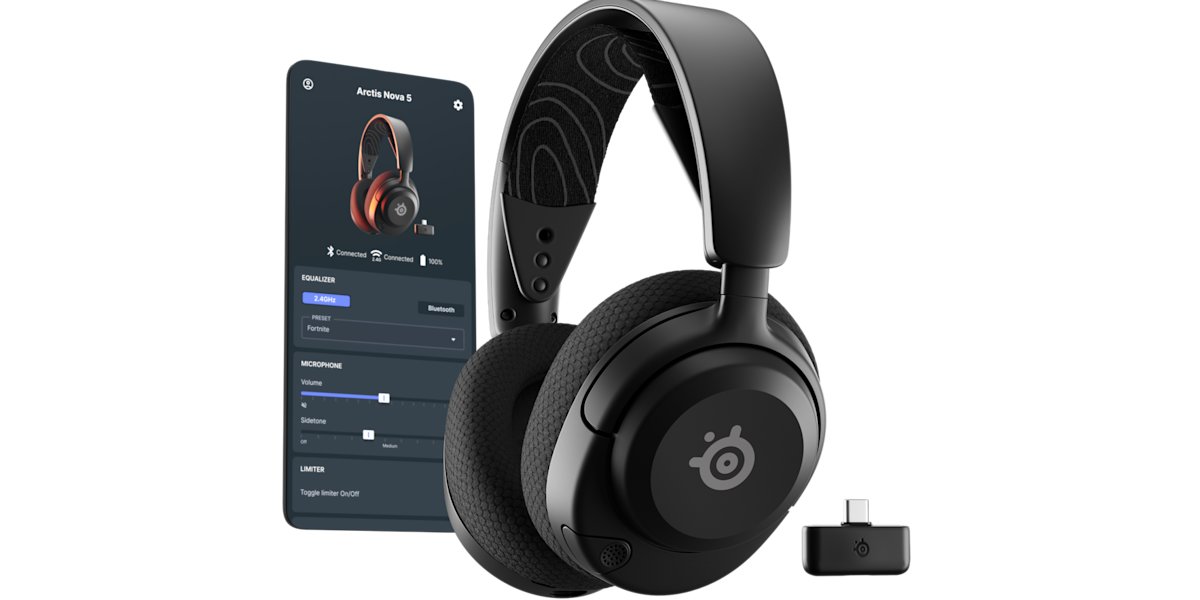
The Arctis Nova 5X Wireless is the headset we recommend when someone asks for a single, sensible all-rounder without spending flagship money. It works with Xbox, PC, PlayStation, Switch and mobile through a compact USB-C dongle, and a dedicated button swaps between 2.4 GHz and Bluetooth in a second. Sound is balanced and clean, with neodymium drivers that handle dialogue and effects well, and the companion app offers more than a hundred game-specific presets plus a full equalizer, which is a real advantage if you like to tune things. The retractable ClearCast microphone is clearer than most built-in designs and is more convenient than a detachable boom, folding away when you are not on voice chat. Battery life is around 60 hours with fast charging that gives hours of use from a short top-up, and the fabric ear cushions are comfortable and breathable. Controls for volume, chat mix and mute sit on the headset itself, so you never need to open software mid-game. The compromises are modest. There is no active noise cancellation, the dongle is a little bulky next to other USB ports, and the build is plastic rather than premium. Buy the version matched to your main console, since the X variant is designed for Xbox while a P version exists for PlayStation. For the money, few headsets offer this much flexibility, comfort and software polish.

Key specs

  • Drivers: Neodymium magnetic
  • Battery: About 60 h
  • Connectivity: 2.4 GHz and Bluetooth 5.3
  • Microphone: Retractable ClearCast 2.X
  • Presets: 100+ game EQ presets

Pros

  • Works across almost every platform
  • Deep app with many presets
  • Excellent battery with fast charging
  • Comfortable fabric cushions

Cons

  • No noise cancellation
  • Dongle is somewhat bulky

#5 Sony INZONE H9 II Best Noise Cancelling

8.7/10

Editor's take

Light, comfortable and quiet when it needs to be, with excellent ANC.

Sony brings its experience with premium noise-cancelling headphones to the INZONE H9 II, and it shows. The active noise cancellation is among the most effective in any gaming headset, which makes the H9 II an ideal companion for people who play in busy households, on the move or anywhere the background is loud. At around 260 grams it is also one of the lightest premium options, with soft earcups and a comfortable fit that holds up over long sessions. A 2.4 GHz dongle serves the PC and PlayStation, while Bluetooth with LE Audio lets you connect a phone, and a 3.5 mm cable is included for wired use. The detachable boom microphone uses AI noise reduction and sounds good. The tuning is built for competitive games, with a lively upper range that brings out footsteps and effects. That emphasis is excellent for shooters but less flattering for music, so you may want to adjust the equalizer in the PC software, which also provides spatial sound with head tracking. There are drawbacks. It is expensive for a gaming headset, the battery life is decent rather than exceptional, and Xbox support is limited. Pick the INZONE H9 II if comfort and noise cancellation are your top priorities and you are happy to pay for premium audio engineering. If you only play in quiet rooms and want maximum battery, cheaper models will serve you just as well.

Key specs

  • Noise cancellation: Active, adaptive
  • Weight: About 260 g
  • Connectivity: 2.4 GHz, Bluetooth LE Audio, 3.5 mm
  • Battery: About 30 h
  • Microphone: Detachable boom with AI noise reduction

Pros

  • Excellent noise cancellation
  • Light and comfortable for long sessions
  • Useful PC software with spatial sound

Cons

  • Expensive
  • Modest battery life compared with rivals
  • Tuning is aimed at games more than music

#6 Logitech G435 LIGHTSPEED Best Lightweight Budget

8.0/10

Editor's take

A tiny-weight wireless headset that is easy to wear and easy on the wallet.

Logitech G435 LIGHTSPEED product image

The G435 is the headset to look at when you want wireless freedom for the least money and the lowest weight. At around 165 grams it is remarkably light, so it is a very easy headset to forget you are wearing, and that has made it a long-running favourite for younger players, students and anyone with a small head. It connects through Logitech's LIGHTSPEED dongle for low-latency gaming on PC and PlayStation, and Bluetooth lets you switch to a phone or Nintendo Switch. Dual built-in microphones use beamforming to pick up your voice without a boom, which is neat and surprisingly effective for casual chat. The 40 mm drivers deliver a cheerful, bass-forward sound with Dolby Atmos support, and an optional volume limiter helps protect young ears. Battery life is about 18 hours, which is perfectly fine for a few days of play but well short of the long-lasting premium models. The trade-offs are plain: there is no equalizer worth the name, isolation is weak, the build is light plastic and the microphone can be sensitive in noisy rooms. Choose the G435 for casual play, school, travel and as a secondary headset. Serious competitive players will want a more precise, better-isolated model, but for a lightweight and affordable wireless headset it is hard to beat.

Key specs

  • Weight: About 165 g
  • Drivers: 40 mm
  • Battery: About 18 h
  • Connectivity: LIGHTSPEED and Bluetooth
  • Microphone: Dual built-in beamforming

Pros

  • Extremely light and comfortable
  • Wireless and Bluetooth for the price
  • Optional volume limiter for younger players

Cons

  • Basic sound without equalizer options
  • Weak isolation and modest battery

Ranking methodology

We compared independent lab measurements and hands-on reviews from several specialist audio and gaming outlets, weighing sound quality, microphone clarity, comfort, battery life, connectivity and overall value. Models that are widely available in Europe were prioritised, and scores reflect how consistently reviewers praised each headset.

Buying guide

A good gaming headset does three jobs at once: it tells you where the footsteps are coming from, it lets your teammates hear you clearly, and it stays comfortable through a long evening. In 2026 the market has settled into a few clear camps. Wireless is now the default, with 2.4 GHz dongles delivering latency low enough that you will never notice it, and Bluetooth added on top so the same headset can also serve your phone or laptop. Battery life has stopped being a worry on the best models, which run for days between charges, and active noise cancellation has crept down from premium flagships into the mid-range. We compared the most respected hands-on testing from specialist audio and gaming outlets, then narrowed the field to six headsets that each solve a different problem. The HyperX Cloud III S Wireless is the safe all-rounder, the Audeze Maxwell 2 is the choice for people who care about sound quality above everything, the Razer BlackShark V3 Pro is built for competitive shooters, the SteelSeries Arctis Nova 5X Wireless is the easiest recommendation for most people on a sensible budget, the Sony INZONE H9 II brings genuinely effective noise cancellation, and the Logitech G435 LIGHTSPEED is the featherweight pick for casual play and younger gamers. When choosing, start with the platform. Some headsets need a specific console version because of licensing chips, and not every model works on every system, so check the exact variant before you commit. Next, think about weight and heat: a very heavy planar headset sounds spectacular but can tire your neck, while a light model can disappear on your head for hours. Then consider the room you play in. If it is noisy, noise cancellation matters; if you game late at night in a quiet house, open and natural-sounding tuning may serve you better. Finally, think about the microphone and the software. A detachable boom mic is usually clearer than a built-in one, but a retractable mic is far more convenient. Companion apps offer equalizer presets that can transform a neutral headset into one tuned for shooters, racing or music, and the better ones let you save profiles on the headset itself. None of the six models below is a bad buy; the right one depends on how you play, what you play on and how much you value audio fidelity against comfort and battery life. Use the ranking as a shortlist, and let the individual guides below help you decide which compromise suits you best.

Frequently asked questions

Is a wireless gaming headset good enough for competitive play?

Yes. Modern 2.4 GHz dongles deliver latency of around 10 milliseconds, which is imperceptible in practice, and the best models stay connected reliably across a room. Bluetooth is convenient for phones and laptops, but for fast shooters you should use the dongle connection, because Bluetooth adds noticeable delay and can reduce audio quality.

Do I need active noise cancellation on a gaming headset?

It depends on where you play. In a noisy flat, shared room or on a commute, noise cancellation lets you lower the volume and hear detail better. In a quiet room it is a nice extra rather than a necessity, and it usually adds weight, cost and a small drop in battery life compared with similar models without it.

What matters more, the driver size or the tuning?

Tuning and implementation matter more than raw driver size. A well-tuned 40 or 50 millimetre driver can sound better than a larger one that is poorly voiced. Planar magnetic designs offer exceptional detail and bass control but add weight, so judge a headset by reviews of its actual sound rather than the spec sheet.

Will a gaming headset work on both PC and console?

Many do, but not all. Consoles often require a licensed version with a security chip, so a headset sold for one system may not work fully on another. Check the exact variant, the supported platforms and whether the dongle is USB-A or USB-C, since some consoles and handhelds only have one type.