Best ssd 1TB of 2025

Read more

This ranking focuses specifically on 1TB internal SSDs that are widely suitable for consumer desktops, laptops and handheld gaming PCs in 2025. Drives were evaluated on several weighted criteria: baseline and peak performance, consistency under sustained workloads, endurance and warranty coverage, thermals and power efficiency, platform compatibility, and overall value for their intended audience. Performance scores emphasize both sequential throughput and random IOPS, but are interpreted through practical use cases like game load times, OS responsiveness and content-creation workflows. PCIe 5.0 models that show clear, real-world gains over PCIe 4.0 alternatives score highly, especially when those gains appear without extreme cooling or power requirements. Endurance ratings (TBW) and warranty length are critical for long-term reliability, and drives with strong five-year warranties and solid TBW figures are favored. For handheld and laptop-oriented models, thermal behavior and power draw are given additional weight, since aggressive heat or sustained high wattage can throttle performance or impact battery life. Compatibility is another key filter. All selected drives use NVMe and M.2 form factors, but they serve different device classes: standard 2280 for desktops and notebooks, and 2230 for handheld gaming PCs. Products were placed into roles such as best overall, best high-end, best value Gen5, best 4.0 all-rounder and best handheld pick based on how well they fit their primary use case, not just on raw benchmarks. Editor scores reflect the balance of strengths and trade-offs in each role rather than purely technical supremacy.

#1 Lexar NM790 1TB NVMe SSD Best Overall 1TB SSD for Most PCs

9.6/10 ★★★★★

Editor's take

Outstanding PCIe 4.0 performance, generous endurance and a long warranty make the Lexar NM790 the best balanced 1TB SSD for everyday PCs and gaming rigs.

Positioned as a top mainstream PCIe 4.0 NVMe option with very strong performance-per-dollar and endurance at 1TB.

Lexar Lexar NM790 1TB NVMe SSD product image

The Lexar NM790 1TB NVMe SSD stands out in 2025 as the ideal default choice for the vast majority of desktop and laptop builders. It uses a PCIe 4.0 interface, which has matured into the mainstream standard, delivering outstanding performance without the heat and platform quirks that can accompany early PCIe 5.0 implementations. In practical terms, that means lightning-fast game loads, near-instant application launches, and a snappy OS experience, even on systems that are a couple of years old. What elevates the NM790 above rival 1TB drives is how well it balances speed, reliability and cost of ownership. Its performance consistently matches or beats more expensive PCIe 4.0 competitors in everyday tasks and demanding workloads alike. Whether you are handling large game libraries, working with high-resolution assets, or simply want your system to feel responsive over several years, this drive has the muscle to keep up. The endurance rating of 1000 TBW is generous for a 1TB consumer SSD and pairs nicely with a five-year warranty, giving peace of mind to users who write and rewrite large volumes of data. The NM790 is also a strong drop-in upgrade for aging SATA or early-generation NVMe systems. Because it targets general-purpose PC use, it avoids exotic cooling requirements or unusual power draws; any motherboard with a PCIe 4.0-capable M.2 slot can take advantage of its speeds, and it remains perfectly usable on PCIe 3.0, albeit at somewhat lower peak performance. For builders who do not want to chase the absolute cutting edge but still demand excellent responsiveness, the Lexar NM790 hits the sweet spot better than almost anything else at 1TB today. The only real downside is availability volatility: its popularity, combined with broader SSD market swings, can cause it to go out of stock or spike in price. When you can find it at a reasonable cost, however, it is the 1TB SSD that makes the most sense for most people.

Amazon
$ 149 99
Availability: In stock Visit

Key specs

  • Capacity: 1 TB
  • Interface: PCIe 4.0 NVMe
  • Form factor: M.2 NVMe SSD for laptops and desktop PCs
  • Endurance rating: 1000 TBW

Pros

  • Exceptional balance of performance and value for mainstream PCs
  • Often outperforms more expensive PCIe 4.0 SSDs in real workloads
  • High 1000 TBW endurance paired with a five-year warranty
  • Easy drop-in upgrade for most modern desktops and laptops

Cons

  • Market volatility can cause temporary stock shortages
  • Pricing can fluctuate significantly depending on demand

Brand: Lexar · Model: NM790 · Release: 2025

As an Amazon Associate, we earn from qualifying purchases. Advertising & Monetization Disclosure.

#2 Crucial T705 1TB NVMe SSD with heatsink Fastest 1TB SSD for High-End Gaming and Creation

9.4/10 ★★★★★

Editor's take

Blistering Gen5 performance and an effective heatsink make the Crucial T705 the go-to 1TB SSD for uncompromising gamers and creators with modern high-end systems.

Best framed as a no-compromise Gen5 performance flagship for desktops with robust cooling and top-tier CPUs.

Crucial Crucial T705 1TB NVMe SSD with heatsink product image

The Crucial T705 1TB NVMe SSD with heatsink is built for users who care less about budgets and more about owning one of the fastest consumer drives available. Leveraging a PCIe Gen5 x4 interface and a high-end controller, it posts extreme sequential read speeds up to 13,600 MB/s and writes up to 10,200 MB/s. Random performance is similarly fierce, reaching up to 1.4 million IOPS for reads and 1.75 million IOPS for writes. In practice, these numbers translate into noticeably shorter load times in demanding AAA titles, faster level streaming, and a smoother workflow when handling massive creative projects. The integrated heatsink is not a cosmetic extra; Gen5 SSDs can generate substantial heat when pushed hard. Crucial's cooling solution allows the T705 to hold its peak speeds for longer without rapid thermal throttling, making it particularly well suited to heavy, sustained workloads like 8K video scrubbing, large project compiles, or working with huge texture libraries. For PC enthusiasts running the latest CPUs and motherboards with full Gen5 support, the T705 finally gives storage a performance profile that matches high-end CPUs and GPUs. This drive is also tuned for creators. High sequential throughput and very strong random I/O mean that assets load quickly and scratch disks remain responsive, even when running multiple applications in parallel. Crucial includes a one-month Adobe Creative Cloud subscription with the drive, a small but relevant bonus for creative professionals and hobbyists looking to trial or expand their software toolkit. However, all of this power has a context. Many everyday tasks will not feel drastically faster than on a good PCIe 4.0 SSD, and the T705 commands a significant premium. It truly shines in bleeding-edge gaming PCs and production rigs where every second shaved from large transfers or load screens is valuable, and where the rest of the hardware is modern enough to fully exploit PCIe 5.0 speeds.

Amazon
$ 159 99
Availability: In stock Visit

Key specs

  • Capacity: 1 TB
  • Interface: PCIe Gen5 NVMe M.2
  • Form factor: M.2 2280 with integrated heatsink
  • Sequential read speed: Up to 13,600 MB/s

Pros

  • Among the fastest consumer SSDs available with PCIe 5.0
  • Excellent for cutting game load times and open-world streaming on high-end rigs
  • Handles heavy creative workloads like 8K video and large renders with ease
  • Bundled heatsink helps sustain peak performance under prolonged stress
  • Includes a limited Adobe Creative Cloud trial for creators

Cons

  • Substantially more expensive than strong PCIe 4.0 alternatives
  • Overkill for typical everyday computing and light gaming
  • Requires a PCIe 5.0-capable platform to see its full speed potential

Brand: Crucial · Model: CT1000T705SSD3 · Release: 2025

#3 Samsung 990 PRO 1TB NVMe SSD Best 1TB PCIe 4.0 SSD for Enthusiasts

9.2/10 ★★★★★

Editor's take

Blending high PCIe 4.0 speeds, strong power efficiency and hardware encryption, the Samsung 990 PRO is a standout 1TB SSD for enthusiasts and professionals.

Well suited for users who want fast PCIe 4.0 performance plus enterprise-style security features on a consumer platform.

Samsung Samsung 990 PRO 1TB NVMe SSD product image

The Samsung 990 PRO 1TB NVMe SSD has quickly become a favorite among PC enthusiasts, gamers and professionals who want top-tier PCIe 4.0 performance backed by mature firmware and robust software support. With sequential read speeds up to 7,450 MB/s and writes up to 6,900 MB/s, it maintains a clear edge over many competing Gen4 drives. Random performance and latency characteristics are similarly strong, giving Windows and game launches a crisp, immediate feel. One of this drive's most compelling traits is its improved power efficiency. Compared to the older 980 PRO, performance per watt is up by as much as 50 percent, which matters not only for desktops trying to keep thermals in check but also for high-performance laptops that can exploit PCIe 4.0 bandwidth. You get high throughput without incurring the same heat and power penalties that earlier high-end drives sometimes carried. Security-conscious users will appreciate the built-in 256-bit AES hardware encryption and support for the TCG Opal 2.0 standard. That makes the 990 PRO a solid choice for work machines handling sensitive data, especially when combined with OS-level full disk encryption. Samsung's companion tools make it easy to monitor drive health, update firmware, and optimize settings, an area where the company traditionally excels. The main limitation is platform compatibility: to unlock the drive's full performance, you need an M.2 2280 slot wired for PCIe 4.0 x4. It will function in PCIe 3.0 slots, but speeds will be constrained and some of the value proposition is lost. For modern gaming rigs, content-creation workstations and powerful laptops, though, the 990 PRO remains a stellar 1TB option, delivering a refined balance of speed, efficiency and security features.

Amazon
$ 206 85
Availability: In stock Visit

Key specs

  • Capacity: 1 TB
  • Interface: PCIe 4.0 x4 (NVMe)
  • Form factor: M.2 2280 internal SSD
  • Sequential read speed: Up to 7,450 MB/s

Pros

  • Very high PCIe 4.0 throughput for demanding gaming and workstation builds
  • Improved performance per watt compared with the previous generation
  • Supports 256-bit AES hardware encryption and TCG Opal 2.0
  • Strong ecosystem of monitoring and firmware tools from Samsung
  • Proven reliability track record in enthusiast systems

Cons

  • Requires a PCIe 4.0 x4 M.2 slot to realize full performance
  • Benefits diminish when used in PCIe 3.0-only environments

Brand: Samsung · Model: MZ-V9P1T0B/AM · Release: 2025

#4 WD Black SN8100 1TB NVMe SSD Best Flagship Gen5 1TB SSD for Power Users

9.0/10 ★★★★★

Editor's take

With extreme Gen5 speeds, modern TLC NAND and solid security features, the WD Black SN8100 is a top-tier 1TB SSD for demanding gamers and power users.

High-end WD Black-branded PCIe 5.0 SSD launched in 2025, targeting enthusiasts chasing maximum performance.

SanDisk WD Black SN8100 1TB NVMe SSD product image

The WD Black SN8100 1TB NVMe SSD represents SanDisk's flagship push into PCIe 5.0 for gamers and enthusiasts under the well-known WD Black branding. Built around a customized Silicon Motion SM2508 8-channel controller and modern Kioxia BiCS8 218-layer TLC NAND, it brings extreme performance into a single-sided M.2 2280 package. Sequential read speeds reach up to 14,900 MB/s and writes up to 11,000 MB/s, putting it firmly at the top tier of consumer SSD performance. Random operations are similarly aggressive, rated at up to 1,600,000 IOPS for reads and 2,400,000 IOPS for writes. These capabilities make the SN8100 a formidable choice for high-end desktops built around the latest processor platforms. Complex game worlds stream rapidly, large projects load and save faster, and content-creation workflows see tangible gains when working with huge media libraries or resource-heavy applications. Yet unlike some first-generation Gen5 drives, the SN8100 aims for better thermal behavior and power efficiency. It still draws a meaningful amount of power under sustained load-around 7 W on average-but the single-sided design and more refined controller behavior help it avoid the worst throttling characteristics that plagued early Gen5 attempts. Endurance is rated at 600 TBW for the 1TB model, and the drive is backed by a five-year warranty, which is typical but respectable for a high-performance consumer SSD. The inclusion of TCG Opal 2.02 support further enhances its appeal for users who need hardware-level security on top of raw speed. This model is best suited to desktop builders comfortable adding either a motherboard heatsink or an aftermarket cooler, and who are running platforms with full PCIe 5.0 ×4 support. For those users, it delivers one of the most well-rounded flagship Gen5 experiences at 1TB, combining benchmark-class performance with a more refined power and thermal profile than many early competitors.

Amazon
$ 194 99
Availability: In stock Visit

Key specs

  • Capacity: 1 TB (1000 GB)
  • Interface: PCIe 5.0 x4, NVMe 2.0
  • Form factor: M.2 2280, single-sided
  • Controller: Customized Silicon Motion SM2508, 8-channel

Pros

  • Extremely high sequential and random performance on PCIe 5.0
  • Modern 218-layer TLC NAND and DRAM cache deliver consistent speed
  • Five-year warranty with 600 TBW endurance at 1TB
  • Supports TCG Opal 2.02 for hardware-secured deployments
  • Single-sided design improves compatibility with many motherboard heatsinks

Cons

  • Average ~7 W power draw under load can challenge small-form-factor cooling
  • Requires a Gen5-capable platform and good airflow to realize its benefits
  • Overkill for systems where PCIe 4.0 speeds are already sufficient

Brand: SanDisk · Model: WDS100T1X0M-00CMT0 · Release: 2025

#5 Crucial P510 1TB PCIe Gen5 NVMe M.2 SSD Best Value 1TB Gen5 SSD

8.8/10 ★★★★☆

Editor's take

The Crucial P510 delivers impressive Gen5 speeds and strong efficiency at a midrange price, making it an excellent 1TB choice for value-minded enthusiasts.

Strategically placed below Crucial's T705 as a value-oriented Gen5 option that still offers very high performance.

Crucial Crucial P510 1TB PCIe Gen5 NVMe M.2 SSD product image

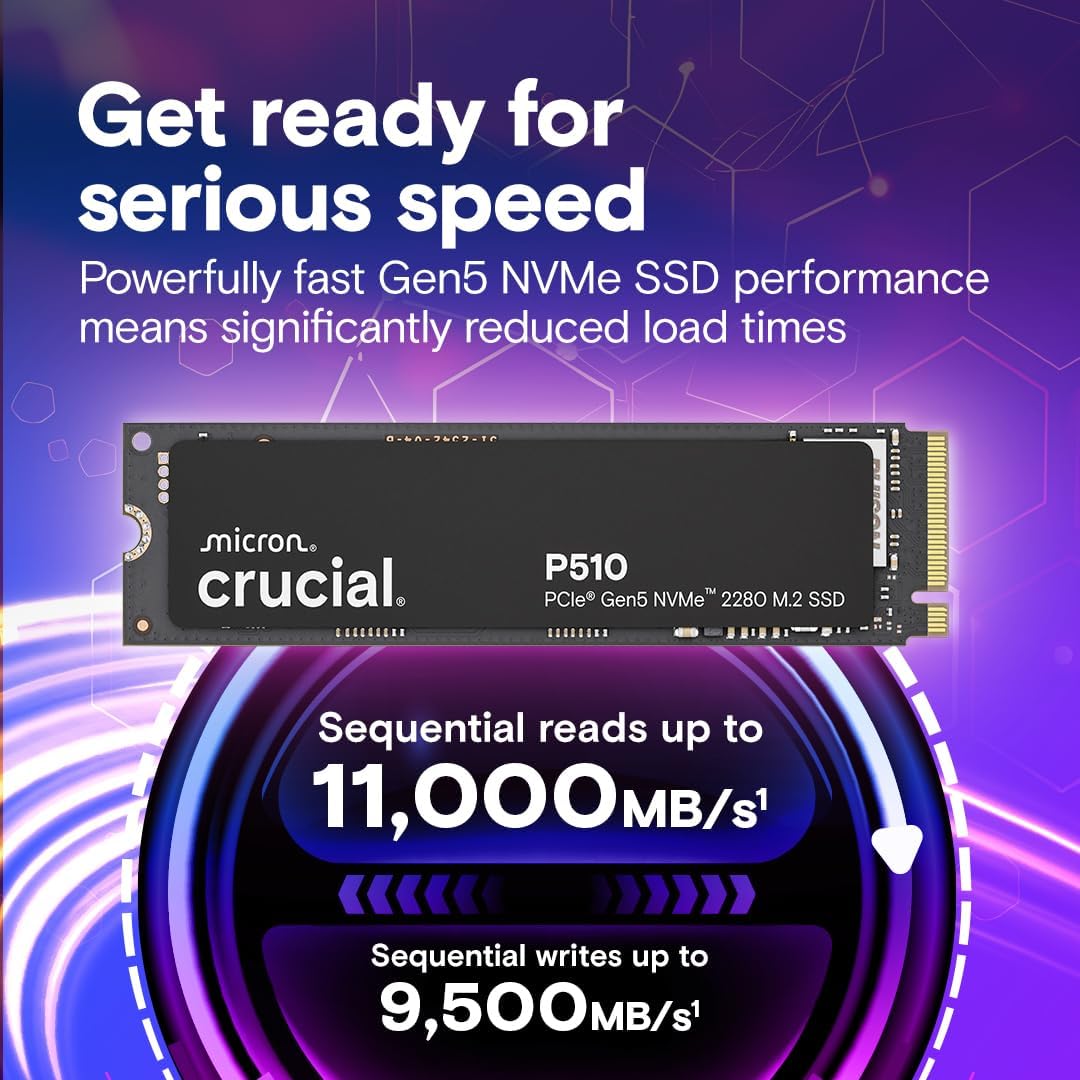
The Crucial P510 1TB PCIe Gen5 NVMe SSD is designed for builders who want to experience the gains of Gen5 storage without paying flagship prices or wrestling with extravagant cooling setups. It leverages a Phison PS5031-E31T controller in a DRAM-less configuration, paired with Micron's advanced G9 276-layer TLC NAND. Despite omitting onboard DRAM, the drive uses Host Memory Buffer technology to maintain responsive performance. On paper, the P510 is no slouch: sequential reads reach up to 11,000 MB/s and writes up to 9,500 MB/s, with random performance rated at up to 1.5 million IOPS in both directions at QD32. In real-world use, that means rapid game installations and updates, very fast asset streaming, and snappy application performance, especially on modern platforms that can fully utilize PCIe 5.0 bandwidth. At the same time, the DRAM-less design helps reduce power consumption by up to 25 percent compared with many DRAM-equipped competitors, which is particularly attractive for laptops and compact desktops where thermals and battery life matter. Crucial positions the P510 as a midrange Gen5 option rather than a halo product. Endurance is rated at 600 TBW for the 1TB capacity, and the drive carries a five-year limited warranty, making it suitable for gamers and power users who write a lot of data but do not need enterprise-class durability. The optional heatsink variant helps manage sustained loads, though many users with decent motherboard heatsinks may find the bare drive adequate. There are trade-offs. DRAM-less architectures can be less optimal for certain cache-sensitive or heavily mixed workloads, and the lack of built-in hardware encryption will be a drawback for some business users. Nevertheless, for mainstream enthusiasts seeking a cost-effective step into Gen5 performance, the Crucial P510 offers a compelling blend of speed, efficiency and value at the 1TB mark.

Amazon
$ 139 99
Availability: In stock Visit

Key specs

  • Interface: PCIe 5.0 ×4, backward compatible with earlier PCIe generations
  • Form factor: M.2 2280
  • Capacity: 1 TB
  • NAND type: Micron G9 276-layer 3D TLC NAND

Pros

  • Delivers true Gen5-level throughput at more approachable pricing
  • Power-efficient DRAM-less design suits laptops and compact builds
  • Backward compatible with earlier PCIe generations for broad adoption
  • Optional heatsink helps sustain performance under heavy workloads
  • Solid 600 TBW endurance and five-year limited warranty

Cons

  • DRAM-less architecture can be less ideal for cache-sensitive workloads
  • No integrated hardware encryption support
  • Thermal headroom is best with a heatsink during prolonged heavy use

Brand: Crucial · Model: CT1000P510SSD8 · Release: 2025

#6 Western Digital Black SN770M 1TB 2230 NVMe SSD Best 1TB SSD for Gaming Handhelds

8.4/10 ★★★★☆

Editor's take

Optimized for the 2230 form factor, the WD Black SN770M brings fast, gaming-grade NVMe performance to handheld PCs like the Steam Deck and ROG Ally.

Strong choice for upgrading storage in compact gaming systems where 2230 modules are required.

Western Digital Western Digital Black SN770M 1TB 2230 NVMe SSD product image

The Western Digital Black SN770M 1TB NVMe SSD targets a very specific but rapidly growing niche: handheld gaming PCs and ultra-compact devices that use the 2230 form factor. Systems like the Valve Steam Deck and ASUS ROG Ally have created demand for drives that combine serious performance with an extremely small footprint, and the SN770M is tailored precisely for that role. Using a PCIe NVMe interface in a 2230 package, the SN770M brings modern SSD responsiveness to portable systems that previously relied on slower or lower-capacity storage. The 1TB capacity is a sweet spot for handheld gaming, large enough to hold a healthy rotation of modern AAA titles alongside indie games and media, yet not so large that it pushes power and thermal envelopes too far. In everyday gaming use, owners can expect faster boot times, quicker game launches and smoother level transitions compared with stock drives, especially when moving from smaller, slower OEM modules. A key advantage of the SN770M is compatibility. Many 2230 SSDs are generic or tuned for business devices, whereas this model is explicitly aimed at gaming. Firmware and performance characteristics are optimized to deliver strong throughput and low latency without overwhelming the limited thermal headroom of handhelds. That said, as with most SSDs in 2025, pricing and availability can fluctuate, particularly as demand from the handheld ecosystem surges. If you primarily game on a desktop or full-size laptop, a 2280 form factor drive will usually be a better fit. But for owners of devices that demand 2230, the Western Digital Black SN770M stands out as one of the most balanced 1TB upgrades available: compact, fast, and clearly tuned for modern mobile gaming workloads.

Amazon
$ 157 77
Availability: In stock Visit

Key specs

  • Form factor: M.2 2230 NVMe SSD
  • Interface: PCIe NVMe
  • Capacity: 1 TB
  • Intended use: Storage upgrade for gaming handhelds such as Steam Deck and ROG Ally

Pros

  • Compact 2230 form factor is ideal for handheld gaming PCs
  • Provides a substantial performance and capacity boost over many stock drives
  • Designed with modern gaming workloads in mind
  • Maintains the WD Black focus on enthusiast-grade performance

Cons

  • Limited primarily to devices that support the 2230 M.2 form factor
  • SSD market volatility can affect its availability and pricing
  • Not as thermally flexible as larger 2280 drives with big heatsinks

Brand: Western Digital · Model: Black SN770M · Release: 2025

How we test

Choosing a 1TB SSD in 2025 is less about simply being faster than a hard drive and more about matching the right drive to your hardware and workload. Today's best 1TB SSDs span multiple PCIe generations, from refined PCIe 4.0 options that balance speed and thermals, to cutting-edge PCIe 5.0 drives that push sequential performance beyond 14 GB/s. On top of that, compact 2230 models finally bring serious solid-state performance to handheld gaming PCs like the Steam Deck and ROG Ally. For this guide, the focus is on real-world use: quick game loads, snappy OS responsiveness, smooth content creation and reliable long-term operation. Peak benchmarks matter, but only when they are backed by solid endurance ratings, sensible power usage, and firmware that keeps performance consistent under sustained workloads. Equally important is compatibility. A blazing-fast Gen5 SSD is wasted in a PCIe 3.0 slot, while a budget-friendly Gen5 drive can be ideal for a laptop where power draw and thermals matter more than synthetic records. The ranking highlights different priorities. The Lexar NM790 leads as an all-around PCIe 4.0 pick that outperforms many pricier competitors while maintaining a strong five-year warranty and high endurance. Enthusiasts who want the absolute fastest desktop experience get the Crucial T705, a PCIe 5.0 monster best suited to top-tier gaming rigs and heavy creative workstations. The WD Black SN8100 offers similarly extreme Gen5 speeds in a more balanced, efficient package, while Crucial's P510 focuses on delivering Gen5 performance at more accessible pricing with a power-efficient design. Samsung's 990 PRO represents the sweet spot for builders who value mature firmware, excellent software support and strong PCIe 4.0 performance, remaining a safe recommendation for demanding PC users. Finally, the Western Digital Black SN770M caters specifically to handheld gamers, pairing a compact 2230 form factor with NVMe performance tuned for portable systems. All picks prioritize 1TB capacity, modern interfaces and meaningful endurance ratings where available. They were ranked on performance, platform fit, thermals and value, ensuring that whether you are upgrading a gaming desktop, a creator workstation or a compact handheld, you will find a 1TB SSD that makes sense for your system in 2025.